


One of the most startling facts revealed at this year’s ABTA Convention in Madeira, was that Intrepid Travel dropped its commercially successful Antarctica charters six years ago after discovering those 13 voyages were responsible for 30% of its total carbon emissions.
For an industry that increasingly sells the White Continent as the ultimate once-in-a-lifetime journey it is a sobering number. So can companies sell expedition cruises and still claim to be truly responsible?
A difficult decision
Intrepid’s CEO James Thornton told delegates that the adventure travel company had ‘made the difficult decision to step away’ from the charters (though it still sells polar expeditions arranged by other operators), and admitted it came at a cost to revenue.
Most were operated by the 199-passenger Ocean Endeavour, a ship that offered its guests luxuries such as an onboard spa, a small gym, a pool and a hot tub. Now 44 years old, the vessel was also previously used by Quark Expeditions, although it has not sailed for the line since 2020.
‘This transition will take time’
Quark Expeditions does not dispute that carbon emissions are an issue for expedition cruises. real. “Operating in the polar regions means witnessing climate change firsthand – and recognising that our own emissions matter,” the cruise line said.
It is candid about why the sector finds this hard. “Our ships travel long distances in remote areas with limited access to alternative fuels, shore power, or supporting infrastructure. Despite these constraints, we remain committed to accurate measurement and data-driven action.”
Quark says that since 2019, emissions intensity per passenger has fallen by 20%, following fleet improvements, more efficient repositioning cruises and higher occupancy.
It describes itself as ‘navigating the path to net zero’, with a decarbonisation strategy built around vessel efficiency, operational improvements and emerging low-carbon technologies. “This transition will take time, and we are committed.”
Travel agent Annika Nickson, who has built her independent business – Nickson Travel – on responsible travel, is also an advocate of expedition cruising.
“The Intrepid figure is a fair challenge, and I don’t think anyone selling polar travel should brush it aside,” she says. “But I am not, and have never positioned myself as, an agent who only sells so-called ‘eco holidays’.”
Her approach is to make every trip a little better – a locally owned hotel over a chain, rail over a short-haul flight, a smaller ship over a mega-ship. And she argues that responsibility is broader than carbon alone: “It’s about giving back to a community, immersing yourself in other cultures, learning about the wildlife of a destination in a respectful way, and hopefully returning home with a newfound respect and inspiration to do more to protect these destinations.”
She points to Aranui Cruises in the Marquesas, an expedition line combined with a cargo ship, as an example beyond cold water expeditions: remote communities depend on both the goods it delivers and the income its small groups of visitors bring, she said.
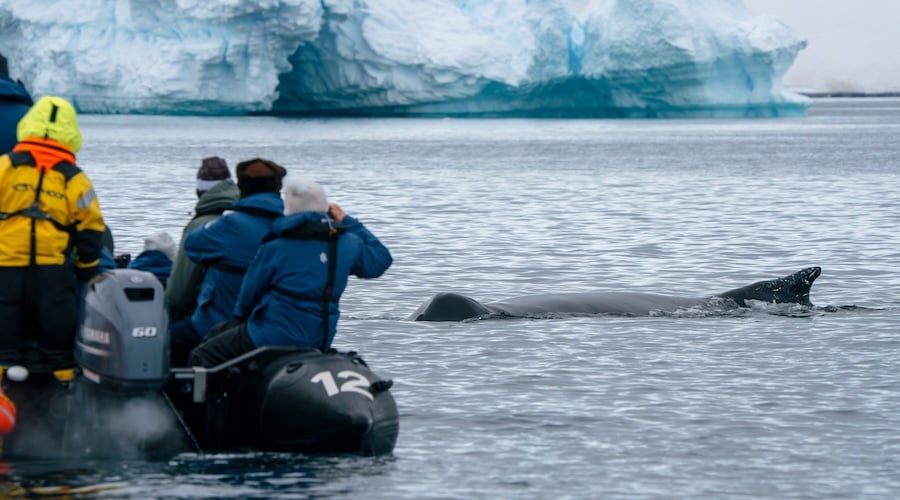
On Antarctica, her argument is pragmatic. The continent is open to tourism, and the public will ask about it. IAATO caps landings at 100 passengers ashore at any one time, and ships carrying more than 500 guests cannot land passengers at all. “The ship size limits in themselves mean that if it is going to happen, expedition is the responsible choice,” she says, adding that they offer far more than larger cruise lines that don’t stop, offering only sail-bys.
Also, Annika points out that expedition ships often carry scientists to areas they could not otherwise study, and guests join citizen science projects such as seabird surveys, water sampling and whale sightings.
It is the big ships she questions. “It is the larger ships, which don’t allow for these immersive experiences, where in my opinion you need to ask whether it is worth the emissions of getting them there for a sail-by with far less benefit.”
Her tip for choosing an operator is look at investment in new ships and technology – emission and noise-reducing measures, and how landings are handled – and ask providers exactly what they are doing. “I believe it’s incumbent on us as agents focusing on responsible travel to be educated enough to advise, because what is the alternative?”
‘We must be realistic’
Akvile Marozaite, CEO and co-founder of the Expedition Cruise Network, believes it is entirely understandable that companies such as Intrepid, particularly B Corps, scrutinise their expedition partnerships.
“We must be realistic: expedition cruising, like the wider maritime transport sector, cannot currently be described as environmentally sustainable, particularly when it comes to carbon emissions,” she says.
Yet she sees an industry actively trying to do better. Emerging operators such as Selar are developing vessels designed to significantly cut emissions in Arctic waters, while established names such as Oceanwide Expeditions are investing in the next generation of expedition ships. “These developments will not eliminate the industry’s environmental impact, but they demonstrate a commitment to finding better ways of operating,” she says.
Like Annika, she argues for a holistic view – wildlife protection, scientific research, conservation, the treatment of crew, community engagement and the economic benefit to remote places. But she is careful with the logic: “None of these factors cancels out the environmental impact of travelling there.”
That thinking underpins ECN’s new Responsible Expedition Framework, a voluntary assessment and communication tool that helps the travel trade understand how operators approach responsible operations across six key areas. It deliberately stops short of certification. “Our objective is not to label expedition cruising as sustainable or to certify individual operators, but to encourage greater transparency, recognise progress and provide travel companies with a more informed basis for choosing partners.
“Responsible expedition cruising is not about claiming that the industry has solved its environmental challenges. It is about acknowledging those challenges, taking meaningful action to address them and continuously striving to do better.”
Our point of view
Can expedition cruising be called truly responsible? On carbon, honestly, not yet – and the most credible voices in the industry are the first to say so. What is changing is the willingness to admit it, measure it and act on it.
Intrepid’s decision deserves respect, but it is one answer, not the only one. Antarctica will keep attracting travellers. If they go, the case for going small is strong: landings, expert guiding and citizen science give a voyage a purpose.
This article was first published on Indulge, Travel Gossip’s website for luxury and experiential travel. For similar articles, go to indulgeluxury.media